

Think back to the best leader you’ve ever had. Now, think about the worst. Chances are, you felt the difference not only in your work, but in yourself.
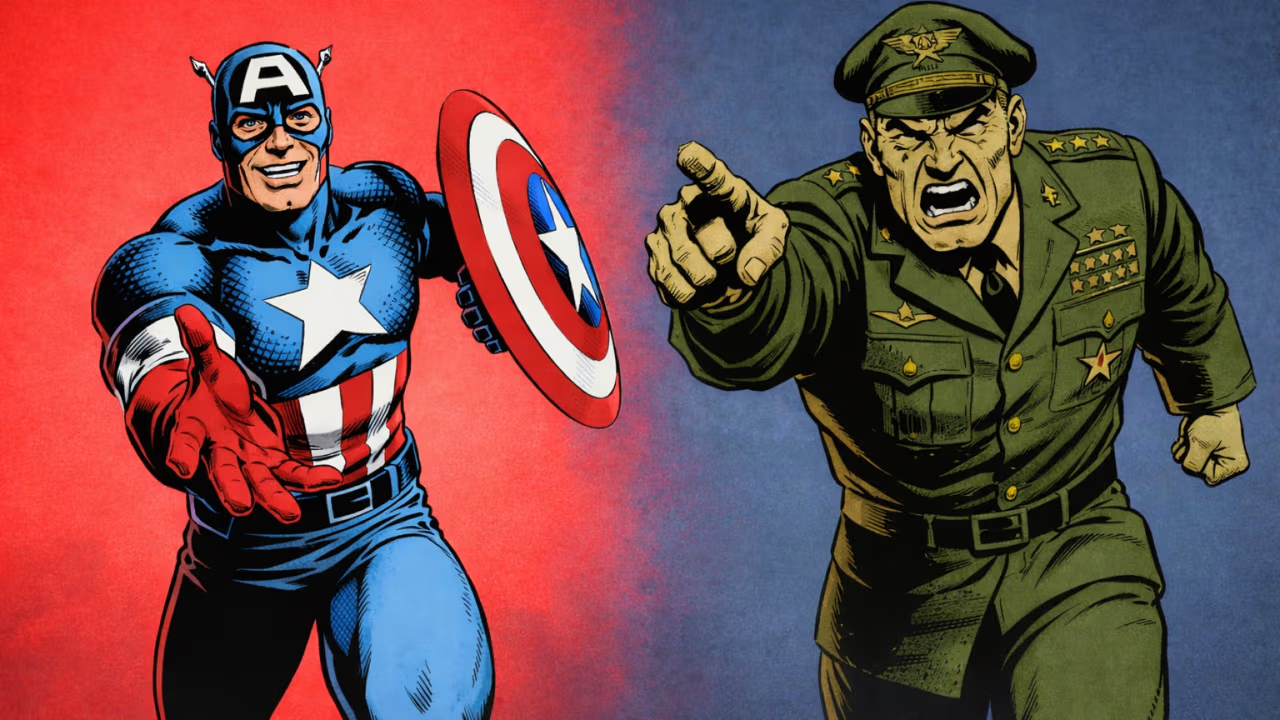
I want to share two leaders from my own career: Captain Amazing and The General. Two people who shaped the way I think about leadership to this day. One restored my faith in what’s possible at work. The other nearly drove me to quit within three days. But they had one thing in common. Both had an enormous impact—just in completely different directions.

From day one, Captain Amazing’s leadership blew me away. Calm, approachable, and deeply empathetic, he carried himself with a quiet confidence. His emotional awareness was sky-high, and it changed everything.
My onboarding under him was unlike anything I’d experienced. I went through Gallup Strengths profiling, not just as a tick-box exercise, but as the foundation for how I would grow. I was coached as a person, as a manager, and as part of a team. Together, we learned how to work with each other’s preferences, personalities, and communication styles. Even he and I went through coaching to better understand how to work together.
That’s when I realised: I didn’t actually know what good leadership looked like until this moment.
The culture Captain Amazing built reflected all of this. Weekly one-on-ones weren’t a formality; they were genuine check-ins. The open-door policy wasn’t just a slogan; it was lived every day. Development, both professional and personal, wasn’t an afterthought or something you had to chase; it was valued and actioned.
One line of his has never left me: “Bring your problems to work. I want to know.”
For the first time, I felt safe communicating, even when the news wasn’t good.
And this mattered. We were in the middle of a recession, losing clients left and right. It was tough. Like, really tough. But instead of crumbling, we pulled together. We supported each other. And we kept moving forward.
The impact of his leadership still echoes with me. He remains a role model, proof that psychological safety isn’t a theory, it’s something a great leader can make real.

Then there was The General.
In his work, he was brilliant. Highly intelligent, incredibly skilled in sales and business. But as a leader? He was the polar opposite of Captain Amazing.
The General dominated every room with tension. His humour was totally inappropriate (which is saying a lot, considering mine). His temper swung like a yo-yo; you never knew which version of him you’d get. Some weeks, he was around every day; others, he disappeared completely.
Our team meetings were stressful. We’d sit in silence at the start of meetings, waiting nervously. And when he finally looked up from his phone, it was often with a cutting remark—something that instantly set the tone.
The impact on the team was devastating. We second-guessed ourselves constantly. No one wanted to approach him, which stalled projects again and again. There was no open-door policy. His door was bolted shut.
The sad thing is, it didn’t need to be this way. The General had so much potential, but his lack of empathy and emotional intelligence made him the most difficult leader I’ve ever worked under.
When I reflect on Captain Amazing and The General, the contrast couldn’t be clearer.
As a leader, you have enormous influence. You can create psychological safety, restore people’s faith in work, and inspire them to grow. Or, you can drive fear, stall progress, and leave people questioning how someone like you made it to the top.
So here’s where I’d like to leave you—with a mirror. Take a moment to peer in and ask yourself:
If these questions make you uncomfortable, that’s not failure; it’s self-awareness. And self-awareness is the first step to change.
Captain Amazing showed me that leadership can build people up, create safety, and unlock potential. The General showed me the opposite: how quickly fear can undo progress.
You don’t get to choose whether or not you have an impact; you already do. The choice is whether that impact lifts people higher or pushes them down.
So I’ll ask you this: When your team looks back on their time with you, will you be remembered as their Captain Amazing, or their General?

Emily Gibson


You can search the RedSeed website by entering search terms below.